
You can shoot a beautiful video or design a gorgeous graphic, and still get eleven likes — because the words failed. In 2026, the brands and creators with the highest engagement invest as much thought into their captions as their visuals. Your caption is not a description of your post. It is a searchable, engagement-driving piece of content that decides how far your post travels.
Here is how to write hooks and captions that actually stop the scroll and earn reach.
The First Line Is Everything
On every platform, captions display truncated — viewers see only the first one to three lines before a “read more” prompt. Those opening words are your hook, and they are all most people will ever see before deciding to expand or scroll past. Get the first line wrong and nothing else you wrote matters.
A good rule for 2026: keep your hook under about 80 characters — roughly 10 to 12 words — so it lands fully before the cutoff. Every one of those words has to earn its place.
Hook Formulas That Reliably Work
You do not have to invent hooks from scratch. These proven structures consistently drive attention:
The Contrarian Hook: “Stop doing X. Here’s what works instead.” It challenges conventional wisdom and creates instant curiosity.
The Number Hook: “I gained 10,000 followers in 30 days. Here’s exactly how.” Specific numbers create credibility and pull people in.
The Question Hook: “What would you do with an extra 20 hours a week?” Questions trigger the brain’s completion instinct — people want the answer.
The Pain-Point Hook: “If you’ve ever posted something you were proud of and got eleven likes, this is for you.” It speaks directly to a struggle your audience feels.
The Transformation Hook: Contrast a clear before and after to create a curiosity gap about how the change happened.
One caution for 2026: avoid the tired, obviously-formulaic openings everyone can now spot — the robotic “3 tips to…” intros. Audiences skip them. Start in the middle of a story or a tension instead, and keep it sounding human, not AI-generated.
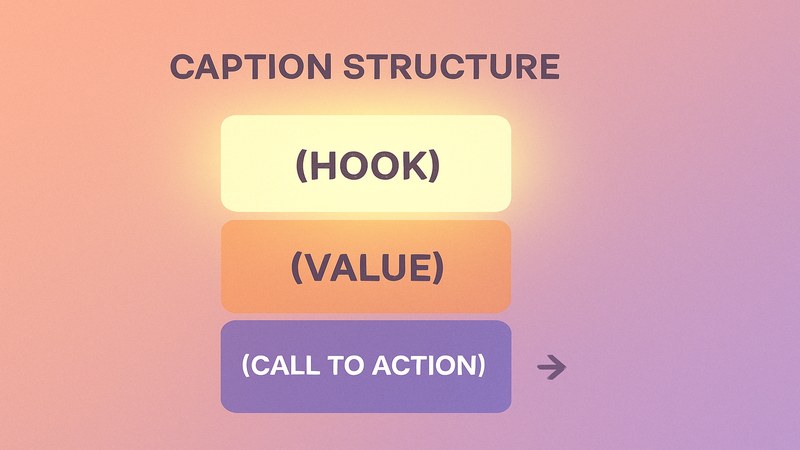
The Caption Structure That Performs: Hook, Value, CTA
The most reliable caption framework is simple: Hook, Value, CTA. A Meta for Business study found captions with a clear structure and a strong call to action see around 23% more engagement on average.
Hook: the scroll-stopping first line. Value: deliver on the promise the hook made — the tip, the story, the insight. CTA: tell people exactly what to do next.
Be Specific, Not Generic
The value section is where most captions die. Generic advice bores people. Specific detail earns trust. Compare these two: “Consistency is key to social media success” versus “Posting 4-5 times a week for 90 straight days grew our reach by 340% — here’s the exact content mix we used.” The second one makes people stop and save. Always reach for the concrete number, the real example, the exact process.
Write CTAs That Drive Saves and Shares
Not all calls to action are equal in 2026. Saves and shares carry more algorithmic weight than likes or even comments, so your CTA should push those actions. Instead of “like this post,” try “Save this for your next content planning session” or “Send this to a friend who needs it.” A CTA that earns a save or a share does double duty — it satisfies the reader and feeds the algorithm the exact signal it rewards most.
Weave In Keywords, Not Hashtags
One more 2026 shift: natural keywords woven into your caption now drive more discoverability than a block of hashtags ever did. Instagram’s algorithm prioritises caption text for search, and platforms increasingly act as search engines. So write the words your ideal viewer would actually search for, naturally, inside real sentences. Your caption becomes discoverable both inside the app and, increasingly, on the open web.
Your Caption Checklist
Before you hit post, run through this: a scroll-stopping hook under about 12 words, a specific and valuable body that delivers on the hook, natural keywords woven in for search, and a clear CTA aimed at saves or shares. Improving just your hooks — that single change — will meaningfully lift your engagement within weeks. Words are not decoration for your images. They are how your content travels.
Even the sharpest caption needs early engagement to trigger the algorithm’s wider push — and for a growing account, generating that first wave of saves and shares is the hardest part. When you want to give a strong post the early boost it needs to get noticed, a trusted SMM service can help provide that initial momentum so your words actually reach people.